Monday, January 28, 2013

Bee Happy Gardeners


This past Saturday, Deberah, Charlotte (a Crossroads Garden Club Member), her husband, Mike and I attended a beginner's beekeepers class given by the Coweta Beekeepers Association. It was an all day event from 8:00 am thru 4:00 pm. The class cost $30 and included breakfast, lunch, snacks and a year's membership into the association, plus lots of publications and catalogs to get us novice beekeeper's started.

Although, Deberah and I grew up with hives in our back yard (my dad kept eight or more hives), we were certainly beginners and needed help and education to keep bees for our garden and to rob hives for our own honey.

The class was organized and took anyone interested in keeping bees (even without any knowledge) throughout the process needed to start a colony. As you can see above, the dress needed to insure no stings. Bees will react to human emotions, like fear or anxiety because we emit a fermion they sense may upset them. On the other hand, if we remain calm they tend to remain calm too. Also, bees are not as suspicious if humans wear white colors, other than dark colors.


We learned the anatomy of bees, above is a worker bee. There are three types of honey bees, workers, drones and queens. The drones are the only male species and their purpose in life is to procreate with the queen. The female workers do all the work to keep the hive, collect pollen and nectar and make the honey. Of course the queen lays the eggs and insures the hive continues to grow and thrive with new bees.

Amazingly, the queen is the only bee that lives very long, the workers and drones, either work themselves to death or out live their usefulness in about 6 weeks. Drones aren't needed in the Fall and are banished from the hive.


We learned about every piece of the hive equipment. Hives can be bought assembled, but it is cheaper to buy hives and put them together. (My dad built his own.)


Deberah, Charlotte and I made a picnic in the hall for lunch.  


After lunch, everyone gathered outside to practice lighting smokers which are needed to inspect or rob the hive of honey. Pine straw is one of the best fuels for this task and very available.


Above is an full assembled hive, shown here with the owner of "Buster's Bees." They sell all the equipment needed to start your own hive, even the bees to put inside. Most hives are painted white and as you can see, the bees don't mind the attractive artwork.


Besides knowing all parts of the honey bee, it's important for beekeepers and gardeners to learn the parts of a flower. 
 
After all we need each other to succeed and Bee Happy!
 
 
Until Next Time .........
 
Happy Gardening 2013!
 
Posted by Wilma Smith

Thursday, January 24, 2013

Training Our Garden Cat


As you may remember, this fall Deberah, Jerry and I got a kitten hoping it would keep those darn critters out of our garden. After some debate we named him, Mr. Basil and since the garden is at my house, he resides with me. As you can see above, Mr. Basil is a Tuxedo cat and to my delight he doesn't shed. The first part of his training included my Corgi, Tia, my Chiwheenie (part chihuahua and part Datsun), Todd and a Schnauzer, Sunny Boy (my mother's dog I adopted after he acquired cataracts and diabetes), and me. We all had to learn to get along living in the house together. But this wasn't hard because Tia took on the role as mother, Todd was a playmate and Sunny Boy couldn't see Mr. Basil so well.


Often, I took Mr. Basil out to the garden to acclimate him to the territory, but I was a little concerned that he might think he was a canine instead of a feline, especially since I taught him to shake hands (very easily) and he was being raised with three dogs. However, recently, as seen above his innate predator genes kicked in and so far he has killed three rats to our excitement. I don't take credit for this training since he was born with hunting instincts.   


When all of us are chilling out, watching TV or napping, Mr. Basil has learned to join in by curling up around my neck and shoulders.

Although, I intend to keep training our garden cat, the first five months have been a success.

So, until next time.......

Happy Garnening 2013!


Posted by Wilma Smith


Tuesday, January 15, 2013

Sweet Peas


If you like an "Old Fashion" flower with an "Old English" flavor, then you might like to add the Sweet Pea to your garden, yard or patio this spring. The Sweet Pea or formal name "Lathyrus Odoratus" is a member of the legume family (or more commonly known in this case as a pea).

It originated from Italy (Sicily) around the year 1700 and although that well loved fragrant climber is all but extinct, today's climbing and dwarf varieties exists due to the efforts of a Scottish decendent named Henry Eckford who crossbred and developed the Sweet Pea into a floral sensation late in the Victorian Era while working as a nurseryman for an English baron. His son John continued to work developing this loved flower after his father's death in 1906.


Last spring I bought a white, purple and yellow dwarf variety and planted them on the west side (back) of my house and they have practically bloomed all year, so I can't praise this pea enough that has shown so much color on the edge of the garden I am trying to establish. I planted Lantanas and Verbenas in between and behind these three Sweet Peas.

The Sweet Pea is an annual, so you can usually order seeds throughout the year, but plants are generally found mainly in spring ranging in pinks, reds, whites, lavenders and in original purples.


Just like any plant in the legume family, they need full sun, rich loamy soil and regular watering during spring through fall. Some climbing varieties are fragrant and make a great addition to floral arrangements.

Since I've been a little dormant through the Christmas Holidays wishing everyone a blessed green New Year!


Until Next time......

Happy Gardening 2013!


Posted by Wilma Smith

Tuesday, January 8, 2013

Seed Starting Class


I have some great news! There will be a seed-starting class on Thursday, January 17 from 7:00 pm until 9:00 pm at the Coweta County Fairgrounds Exhibit Hall. (The above page is captured from the County Garden Farms website announcing the class.) The class will be taught by Mike Cunningham of Country Garden Farms and I can't think of any better person because he probably has more experience than anyone I know.

My sister and I plan have already signed up and though we have had some success growing transplants, we would never turn down the expert advice that will be given at this local seminar. Growing our own transplants is a real money-saver. I think the cost of the seminar will be repaid ten times over in just the first year!

Here is the information from the flyer sent by the Coweta County Master Gardener Extension Volunteers.

“HOW TO GROW YOUR OWN ORGANIC VEGETABLE TRANSPLANTS INDOORS”
presented by
 
MIKE CUNNINGHAM
of Country Gardens Farms
7:00 p.m. – 9:00 p.m.
Coweta County Fairgrounds Exhibit Hall
275 Pine Road, Newnan

Cost: $10 collected the evening of the seminar
(payable by cash or check)

Please register before January 16th by calling 
the Coweta County Extension Office:  770.254.2620

What you will learn
- How to select and buy seeds 
- How to build your own grow light stand
- How to maintain proper temperature, light, moisture and fertility to grow healthy transplants 
- How to schedule ideal planting dates 
- How to transition plants from indoors to the garden 

Mike’s Presentation will include a live demonstration of a grow light stand,
heating cables and plants.  He will also provide step-by-step instructions along
with a detailed handout.

Reasons for growing your own vegetable transplants 
- You can order any seed over the Internet and grow your own transplants and not be limited to the varieties that are available at nurseries in the spring. 
- You can grow your transplants organically yourself 
- Depending on how many you grow you can save money

Friday, December 28, 2012

My Favorite Neighborhood Store -- Tractor Supply


Several years ago a Tractor Supply Co. was built at Thomas Crossroads close to my house (I could walk through the woods, if I was inclined in less than ten minutes). Charles E. Schmitt founded the store in 1938 mainly to serve farmers and ranchers, but with over 7 decades (74 years), customers grew to include small farmers, businesses, novice gardeners, pet owners (any kind), and anyone needing all types of tools, fencing, clothing and footwear, hardware, truck accessories, supplies for livestock, equines, dogs and cats, even more, just too much to name.

I had never heard of a Tractor Supply Company, yet it didn't take long for me to realize, it was a lot of stores wrapped into one. And it is always an experience for me to visit, whether I just browsed or bought anything.


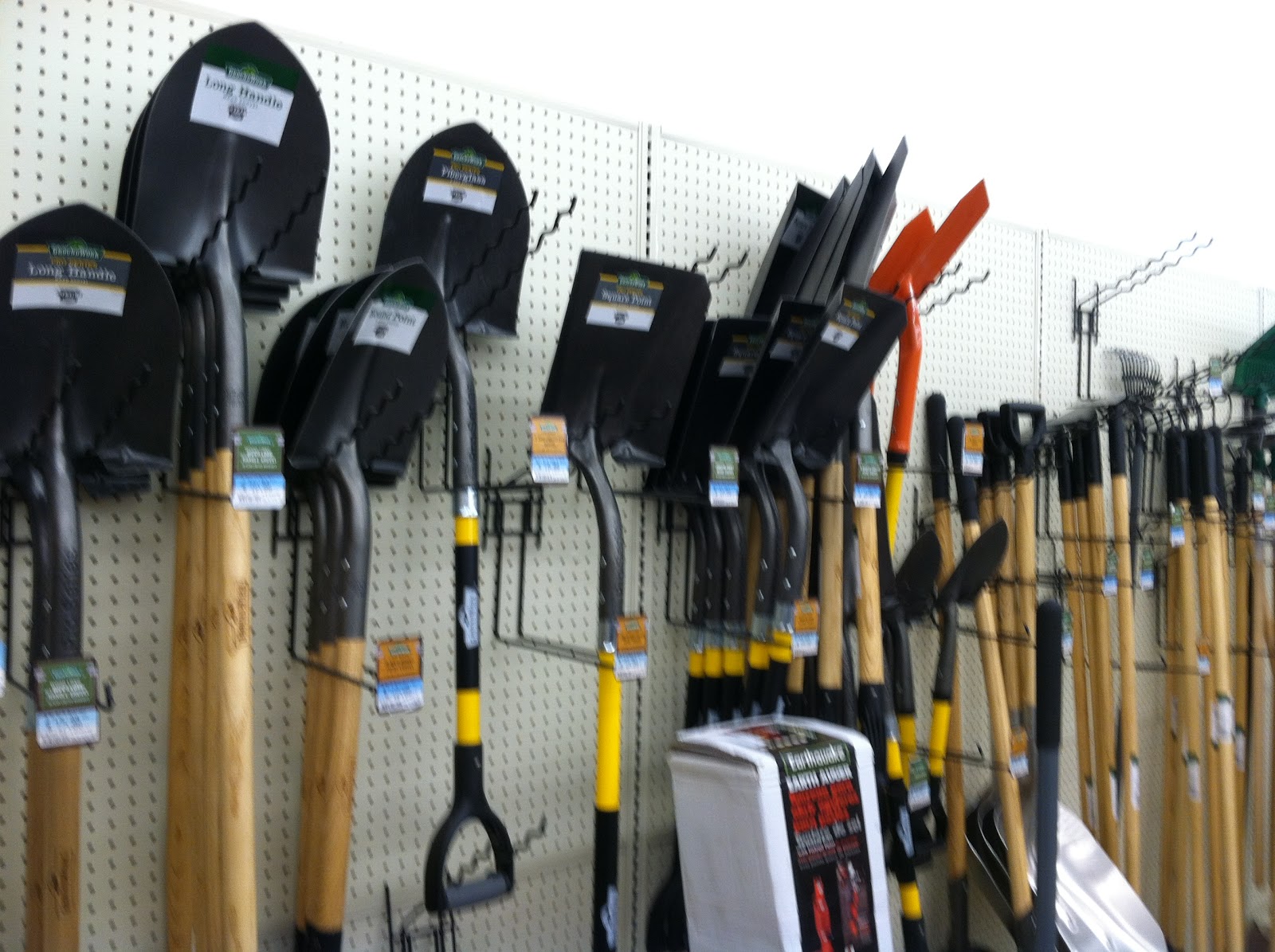
Most garden tools are available in the garden section.


Pick your favorite color of the watering cans.


Gloves are not a problem for any job.


The hat rack holds garden and cowboy hats.


You may meet an animal lover with her teacup friend.


The store stocks dog and cat food supplies, too, all year for my four legged kids; Tia, Todd, Sunny Boy and Mr. Basil like the dry and canned varieties.


I love the variety of metal tubs and buckets.


I also like the smiles and good customer service.


I noticed this famous cowboy next to some of the gift shelves.


When I was growing up we had a black and white pinto like this horse named "Thunder" (but without the rockers).


As, I checked out I got more smiles and more good customer service from two check-out clerks.


If a Tractor Supply Co. is not close to visit, you can browse on line at TRACTORSUPPLY.COM or order by phone at 1-877-718-6750 (There is also a Blue Book Catalog).
 
 
Until next time......
 
Happy Gardening 2012!


Posted by Wilma Smith

Friday, December 21, 2012

All I Want for Christmas is a Mud Puddle


This year what I really wished for Christmas was rain, lots of rain and during the week before Christmas 2012, I got my wish! The drought in our area of Coweta County has been devastating this year. Not only for gardens and yards, but for trees and shrubs, even wildlife that rely on wild flowers, berries and water in local ponds, streams, and ditches that fill with such. 

So, instead of two front teeth, I wished for mud puddles because I knew, if we had those, we would have had several inches of rain.


Rain brightens any landscape, especially plants in a garden. The next few photos are of our garden and the update for this month. Above are bok choy blooms. We'll cut them, dry them and save the seeds to plant in spring. I was excited to see plenty of honey bees doing their thing, as two years ago, we didn't see many


Even with the drought, our broccoli is heading with florets.


Some people don't like the earthy flavor of turnips, but I love these "Purple Tops," boiled, mashed and add butter, like potatoes.


We've had several meals of collards and even gave a neighbor a mess for their Thanksgiving dinner.


Lettuce loves the cool weather and especially the rain.


Our strawberries will produce next spring. They turned a beautiful green with the rain.


We still need lots of rain to fill up the pond, so we can use it next year to water the garden.


Merry Christmas to you, your family and hope all your wishes come true this holiday season! 
 
I hope rain falls on your garden endeavors and leaves a mud puddle for you!!
 
 
Until Next Time.......
 
Happy Gardening 2012!
 
 
Posted by Wilma Smith

Saturday, December 15, 2012

Forcing Bulbs Indoors for Holiday Color


I've enjoyed the gift of color by forcing Amaryllis bulbs to bloom indoors prior to Christmas and throughout the winter season for the last several years. This project can be fun for children, as well as, any adult who loves a little dirt under their nails.

This bulbous, trumpet flower was cultivated in the eighteenth century and it's origin and genus disputed from 1938 until 1987 when the "International Botanical Congress" declared Amaryllis belladonna, as the Hippeastrum genus originating from South Africa. The other contender was found in South America. Who knew the Amaryllis could have waged such a political plant cliff, similar to the financial cliff in our Congress today!

Due to the controversy and confusion, Carl Linngleus gave all these plants the common name "Amaryllis" in 1753. Making this "family" or "genus" as the bulb found in most kits sold for Christmas gifts and forced blooming during winter months.


I found this variety on sale at Tractor Supply, as you can see above for $4.99. Most cost $10 to $12 dollars and that's still a good price for the beauty, enjoyment and color lasting throughout most of the winter months. Although outdoor Amaryllis, naturally range in pinks and purples, these hybrid bulbs packaged for forced blooms may be bought in pink, salmon, white, apricot, rose and of course, deep reds, like scarlet. Their flowers can be found in single or double blooms with solids or striped colors of four to six circular patterns.


Kits will include the bulb, a rich, loamy soil and a pot for easy planting, basic for forcing any bulb. Plant it with the bottom covered in dirt (1/4 to 1/3 inch) most pots should be two or three inches larger in diameter than the bulb and allow adequate drainage to prevent rotting in standing water. I don't like this cheap pot, but it does OK for this illustration.


After potting your Amaryllis, place it in a window with good, but not direct sunlight and water only when the dirt on top feels dry. Never allow water to stand in the container, as it will rot the bulb.

Believe it or not, these bulbs can be planted outdoors in our climate, after the danger of frost. Keep the flower stalk on the plant until it dies and turns yellow, acclimate the bulb in shade or indirect sunlight. This resting period allows the nutrition of the flower stem to energize the bulb for next year's blooming. Amazingly, a little bright sun, after resting helps the bulb transition to outdoor living.


Mr. Basil, our garden cat at first seemed interested in this earthy project.


It wasn't long before he found a sunny spot in the grass to chill out.


I'll keep you udated on the "Red Lion" variety of this year's Amaryllis blooming on my windowsills with photos and hope you share yours with me!

Most any bulbs you favor can be forced to bloom during winter months and transplanted to your yard in spring. So, no doubt that's a win...win for any gardener.


Until next time....

Happy Gardening 2012!

Posted by Wilma Smith